Sea serpents
at the coast and in the fjords

The sea horse, the Norwegian dragon.
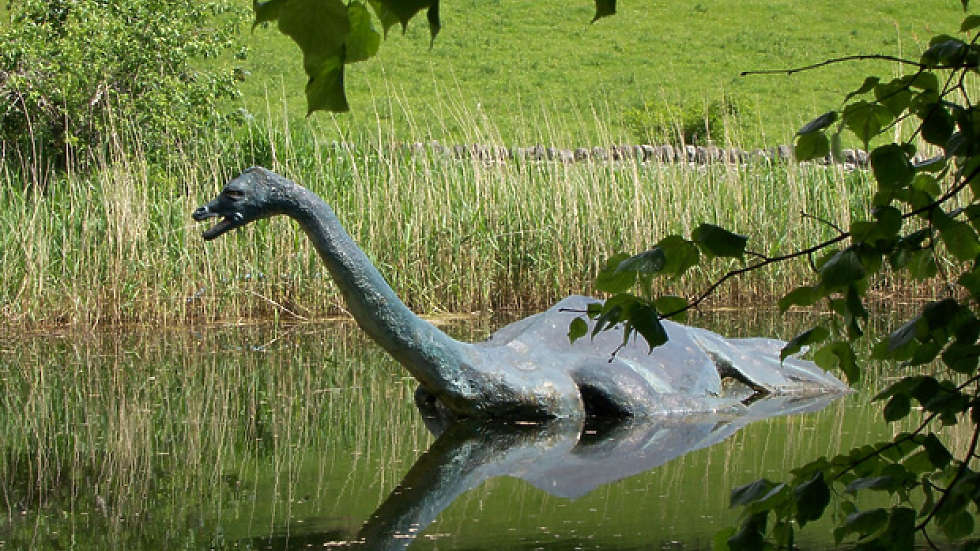
All along our coast there is a milennium old tradition around this rare sea creature ordinarily called sea serpent, but commonly referred to as a SEA HORSE (havhest). Partly that tradition is treating the creature a mundane being, partly it contains all the superstitions necessary to guard oneself from the sea horse. Its head has often been compared to a horse`s head, sometimes it has a mane down its neck, it has got big eyes and a longish body that sometimes displays one or more humps. The colour range is from greywhite, to brownish, dark or black, - with a lighter belly. The sea horse has also be seen on the shore. Judged by the written evidence about this creature it is rarely dangerous to people, although it at times emerges appallingly close to boats either by curiosity or for other reasons. Tradition relates this pushy behaviour to the mating season, supposedly July and August, when the creatures occasionally have been seen trailing or investigating small wooden boats. This stalking has rarely happened to modern boats with noisy engines. The sea horse has also been rapported in lakes and with identical descriptions as the salt water variety. The two appear to be the same species, able to live both in the sea as well as in fresh water. In old times the sea horse was called LINDORM (lindorm) when it was encountered on land descending from smaller ponds or lakes down the waterways to the sea or to richer feeding grounds in bigger lakes. Some times this migration caused them to perish in steep and narrow waterfalls or to be killed by humans. Other names were WATER HORSE (vasshest) and WATER TROLL (vasstroll).

The sea serpent.
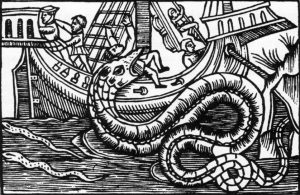
The rarest of all sea creatures, the classical SEA SERPENT (sjøorm), a pointed head, a gigantic serpentine body often 1 1/2 m thick or more and some fins present on the body. At times fishermen thought it to be aggressive, escaping on to dry land if they met one, or any sea serpent for that matter. This type has never or seldom been rapported in any lake. People along the coast knew both kinds. There actually is preserved an anecdote about a fight between individuals of the two types, in which the sea horse came out victorious.

There exist old stories like the ones stained with superstition as shooting silver bullets and weapons like iron spiked logs, old anecdotes, stories which has precise time and location as well as names of eyewitnesses, mass sightings and also sworn affidavits from courts. They originate from Hvaler island in the south close to the Swedish border, all along the coast with the numerous fjords, islands and skerries, up to Ingøy in Finnmark probably the northernmost sighting of the world at 71 degrees 5 minutes northern latitude.

[Click-on-map of southern Norway]

ØSTFOLD - 2

At Hvaler
August 4th 1902. In the afternoon minister Hans Davidsen was out sailing in the outer Oslo fjord together with six other adults and four children. The sail boat enjoyed a light breeze with a slight dribble of rain on the calm sea. One of the passengers suddenly raised an arm pointing at something: "What is that over there?" Everybody had a look, and 300 yards away they spotted an unknown sea creature. It came from Heia and was heading for Koster. As it passed them aft, they calculated its speed to16 knots. Three gleaming humps stood out against the surface of the sea, and it had a head that swayed from side to side. From the movements in the water they estimated the length to 15 - 20 meters. They watched it both with their bare eyes and through a pair of binoculars, and got convinced that it definitely was not a number of animals swimming in succession. Davidsen recorded this event in his parish book at Hvaler, and he made a sketch of the unknown creature.

Ellinggårdkilen at Onsøy
A centuries old anecdote : In the Ellinggård inlet a sea serpent used to go ashore to prey on calves of dairy herds. There soon was a trail from the sea leading up to the pasture. No farmer wanted to take the calves indoors, as they then expected the sea creature to cause still worse damage. Not even bullets of old silver did any harm to it. When the congregation was assembled in prayers for protection, the sea serpent took still more calves. One brave and strong man then made a club of solid oak tree and hid to ambush the animal. When the sea serpent finally arrived, he struck a deadly blow thus killing the beast. The tradition says that one of the vertebrae parts for years was used as a milking stool in the barn of Ellingsøy farm.

AKERSHUS/OSLO - 1

Outside Drøbak
1827, August. The sea serpent was seen in the inner Oslofjord by five people. Then it was seen in the Bunnefjord, in September at Nesodden, and at Drøbak where it was observed by sea captain Helmer, his wife Ida Mathilde Helmer and a pilot. The creature wriggled slowly along the surface. It was long and as thick as a yard arm. The tail was like a fish tail, and the head was like an eel`s head. They sailed alongside the sea creature and had ample time to study it.

AUSTAGDER - 1

Gressviktangen at Grimstad town
1980. It was a warm and nice August day outside Gressviktangen at Grimstad. Something that rose out of the sea 70 - 80 meters away caught the attention of the witness ashore. One hump, then two more surfaced. Accidentally she had brought a pair of binoculars this time. Training it towards the creature floating calmly in the surface, she saw that it was brownblack in colour. She watched the creature for a while before it slipped under the surface.

VESTAGDER - 2

Søgne
1982, August 7th. The newspaper Fædrelandsvennen reported that four people had seen the sea serpent, among them Else Marie Flaen. She told that, at a distance of 50 meters from their boat they could see three coils (or humps) with a space of 1 meter between each. They were sea experienced people, however not able to identify the greyblack sea creature. 

The Mandalsfjord at Mandal town
1867, July 13th. Eight witnesses testified in a court at Mandal that they had seen the sea serpent this particular Saturday. Two of them were Gunder Jørgensen and his young son Søren who had a very close encounter with the sea serpent at the Hvilling skerries at Gismerøya. The pointed head had some sort of protuberance on each side. At one point Gunder tried to chase it off, but in vain. Watching from the skerries they witnessed the creature slowly patrol the fjord for half an hour before it took off, leaving a powerful wake behind it. It swam with obvious vertical movements. The visible part of the back was 10 meters, but Gunder assumed the total length to be far longer adding submerged parts of the creature that he could see move water. See specific page.

ROGALAND - 2

Furious sea horse versus angry sea serpent
Ølensundet in the Boknafjord
The centuries old legend. Stripping the original story of its superstition and religious coating, the core of the story runs like this. A sea serpent entered the Boknafjord and settled in the sound at Ølensundet near Hjelmeland. This caused the local inhabitants a lot of trouble as they were cut off from using the fjord. Some time later three sea horses were seen at Skudesneshavn, of whom two continued on their northernly course, the third one veering off into the wide Boknafjord. When it arrived at Ølensundet, the sea serpent had just left, the sea horse immediately following in hot pursuit. The surface of the sea soon was a turmoil of waves and spray from the two racing sea creatures, until finally the sea horse succeeded in hunting down its arch enemy. People now witnessed a fight they had never anticipated. The sea got red with blood from the two combattants, until finally a deadly bite from the sea horse got a fatal hold of the neck of the sea serpent. Visually hurt the victorious sea horse left the fjord for the sea.

Other stories with more or less the same theme makes the story a true wandering legend. They all happened in fjords, one actually in a lake. As with all myths they are often based on true events. Who knows if this really happened.

Outside Karmøy
1830-ies. This happened to Anders Eliassen who was born in 1795 and lived at Sør-Håland. In the 30-ies Anders and his neighbour once was out fishing south west of Karmøy. Suddenly the men saw the boat fairly close to them take off and head for land, far too early than normal. Anders brought forward his telescope and soon spotted a sea serpent, It was was really huge, and it had a head that looked like a horse`s head with mane. Quickly they cut the fishing lines and started rowing for land. The sea creature constantly gaining on them undulating through the waves, they literally rowed for their bare lives. The situation turned dangerous since the orm was fast coming closer. Suddenly it made a final plunge towards their boat to sink them but did not quite reach them. People watching the drama from land helped the two exhausted fishermen on their feet, who were now spitting blood. Even their finger nails were bursting with blood. They were helped inside and stayed in bed for three days.

HORDALAND - 2

The Bjørnefjord
Johannes Furuberg in Mauranger was on his way to Bergen to buy grain. He had borrowed a gun to defend himself in case he met the sea serpent. In the Bjørnefjord he saw somthing that he assumed was a cluster of fishing boats. It was not. It was the sea serpent, and he tried in vain to outrow it. When it got close to his boat, it raised its head high. Johannes said a prayer, and pointing the gun directly into the mouth of the monster he pulled the trigger. The orm sank out of sight and coloured the sea red with blood. Johannes loaded the gun again, but the sea serpent stayed under.

North of Bergen city
1745. A fisherman met a long, big and strange animal north of Bergen. It came swimming towards his boat and got so close that the waves hit the boat before the animal submerged and was gone. The head looked like that of a a seal, the body was thick, and it was long as a big boat.

SOGN OG FJORDANE - 1

Between Bergen city and Sogn
1845. J.D.Morries Sterling sent a letter to the Illustrated London News in 48 that referred to bishop Neumann in Bergen who had collected several sea serpent sightings from well respected men. The yacht of Morries Sterling once lost the wind and was drifting in a calm sea. Something whipped the surface a quarter of a sea mile away from his jacht. With his telecsope he could see three humps, and he estimated the total length of the creature to 10 meters. His Norwegian captain saw the same.

MØRE OG ROMSDAL - 5

Hjørungavåg
A sea serpent once stayed in the fjord blocking the entrance to the narrow Hjørungavåg. It had twelve coils. Bishop Gudmund Arason (1161 - 1237) is said to have expelled the sea serpent with prayers and holy water, a parallell event with year 565 when the missionary monk Saint Columba`s (521 - 597) prayers drove away a monster in River Ness which runs from Loch Ness to the sea.

The Hessafjord at Ålesund town
1999, June 2nd. Arnt Helge Molvær from Sula near Ålesund
had gone for a walk along the fjord. Then he saw a strange creature coming from the left of him, swimming 200 m off and parallell to the shore line. He described it like this: 25 - 30 meters long, 1,5 meter across and tapering towards both ends. 1/3 back from the head there was a dorsal fin 30 - 40 cm high; a kind of sqarish fin that was higher at the front end. He watched the strange animal for about 10 minutes through his 7 x 35 binoculars before he decided to run home for his video camera. The animal was still in the fjord, now busy at a floating whale carcass. The video tape reveals little detail due to the long distance. See specific page.

Juleneset at Molde town
1746 August. Lorentz de Ferry was returning from at trip to Trondheim when he encountered a sea serpent at Juleneset near Molde town. De Ferry shot a load of pellets into it with his flintlock rifle. The animal was hit to some extent and fled. Description: The head was held two feet above the water the same shape as a horse´s head. Its colour was sort of greyish, and the snout was was quite black. The eyes were very big, and a long, white mane hung from the neck into the water. The body was very thick, 7 - 8 humps were visible, and an estimated distance of 6 feet between each hump. Lorentz de Ferry and two of his men testified their adventure in a court in Bergen. See specific page.

In the Romsdalsfjord
1815, July 28th. Book store owner J.C.Lund, merchant G.S.Krogh, Lund`s apprentice Christian Flang and worker Johan Elgesen met a gigantic sea serpent in the fjord. These four men were out fishing in the Romsdal fjord. It was a sunny day and the sea was quite calm. At 7 p.m. they saw a big sea animal. When it had arrived at a distance of 270 yards, they were able to see that the body ended in a pointed snout.  The head was darkbrown and the skin was smooth. They were not able to see the eyes, nor were they able to see a mane or hair on the neck. It moved forwards by the help of ten fins on the front part of the body. They were able to see the head because of the waves around it. The visible part of the body was 40 - 50 feet long, and round with a dark skin. Apparently it was several feet thick. It moved with snakelike undulations.When they discovered an undulating movement behind the animal, they assumed that the rear part of the animal must be submerged. It was clear by the way it moved that it was all one enormous animal. The gigantic head lifted out of the water forming a semi circle. 

When the orm had come within shooting range, Lund fired his flintlock gun at it. He was quite sure that he had hit the head. The orm dived, only to surface again shortly after. It raised its neck like a snake that looked for its prey. Upon turning around, it stretched the body, a movement that looked painful, then quickly targeted the boat. The men responded by immediately turning the boat towards the shore. When the animal detected that it began entering shallower water, it dived and left the area.

Kristiansund town
1847. The sea serpent used to be seen every summer in warm weather. Among dozens of highly respectable eyewitnesses, the fisherman Lars Johnsen had seen the sea serpent at close range. The creature emerged hardly more than a couple of meters away from his boat, causing Lars to lie down in the bottom of the boat. Still he kept his head up studying the sea creature. It vanished, reappeared, only to finally submerge when a breeze blew up. Lars said it was 35 meters long, with an even, rounded, 2 feet thick body that moved vertically. The head was long and large with 2 inches big, red eyes. A mane down the neck started as a fin, flowing to both sides when it swam.

SØR TRØNDELAG - 1

Brekkestadbukta at Ørland
An old anecdote. A sea serpent entered the Brekkestad bay close to the entrance of the Trondheim fjord. It stayed there patrolling the area, forcing the fishermen to stay on land. No one dared go out fishing, until the blacksmith Jørn Hovde solved the problem for them. He rammed a lot of iron spikes into a log and went sea serpent fishing in the bay. When the sea serpent came, he sent the spiked log forward. The creature attacked the log, and eventuallyt got itself killed from the spike wounds.

[ Click-on-map of northern Norway]

NORDLAND - 4

Vegglandet in the Sagfjord
In the Sag fjord there is one single story of a sea serpent, back at the time of WW2. Some Finnøy fishermen detected a beached creature at Vegglandet that had a head like the head of a small horse or a foal. However, when moving the boat closer, they saw the creature plunge into the sea and disappear.

Brynilen in the Tysfjord
Some fishermen were outside the north side of Brynilen. Two boats were anchored to allow the crew to sleep. Suddenly one of the fishermen saw a head come out of the sea. The beast stretched its neck and peeked down into the other boat. Then it disappeared but surfaced again on the other side of the boat. Suddenly it lunged forward and pressed the boat down into the water causing both boat and crew to disappear. The two fishermen of the other boat hurried towards the safety of the nearest shore, but they had to stay there for two days before the sea serpent left the area. There are other stories about narrow escapes, but none as dramatic as this one.

Bogen in the Ofotfjord, west of Narvik town
1914. At Bogen the sea serpent arrived in 1914, when it happened to enter the Ofot fjord. It was a hot day and the sea was dead calm. The orm criss crossed the fjord, passing the rocks, skerries and islands, before it headed for the sea again.

The inner part of the Ofotfjord
The accountant at Ofoten iron ore company was testing his fishing luck in the company of some ladies. Further out in the fjord they spotted the head and the long neck of an animal that was raised abrubtly out of the water. Behind the neck they were able to make out a row of humps. The sea serpent slowly moved forward leaving a v-shaped wake behind. Now and then it stopped as if to check on its bearing. The people watching from the quay knew well visiting seals and porpoises that showed up from time to time, but this creature was quite new to them. The fuss drew even more people to the docks to watch this strange and weird creature. The harbour master entered a boat to go out and study the animal. The amount of noise at last caused the sea serpent to turn back to the open seas.

FINNMARK - 4

The Sandøyfjord at Sørøya, west of Hammerfest town
An old anecdote. The sea serpent entered the Sandøyfjord and stayed there. No one dared to go fishing except for an old man who knew what to do. He told the people to have made a lot of iron spikes and hammer them into a drift log he had found. Then they were to push the log out in the fjord next to an anchored boat and start banging on the boat. So they did. When they started banging on the empty rowing boat, the sea serpent surfaced. It saw the log and attacked. The log started rolling in the water, and in fury the sea serpent coiled itself around it. The dead sea serpent later drifted ashore. No animal or bird ate from the carcass except for some birds who died doing so.

Ersvika, south of Hammerfest town
1894. Two sea serpents seemed to settle close to land in Ersvika. The fishermen were landlocked for three days by the sea creatures being so offensive that the fishermen were not able to row out fishing. Nor dared they go past the pushy critters to summon the whalers in Hammerfest town. Many people saw these two sea serpents for most of two months.

The northernmost sea sighting in the world, at 71 degrees 5 minutes north!
The island Ingøy, north of Rolvsøy

1910. In his youth R. Eliassen was together with his father at Ingøy. One day an extraordinary thing happened when they were out fishing. They saw something that suddenly rose 1,5 m out of the water. It was a long neck topped by a narrow head. Behind the neck a small hump surfaced, and a bit further back another still bigger hump appeared. Seeing this they quickly pulled in their fishing lines and rowed for the shore. The monster disappeared, but soon it surfaced again. It swam away dipping its head in the water like a duck. A short while passed, then it submerged for good.

Havøysund
Store Latøya, south east of Ingøy
Some men from Kvænangen had been fishing at Havøysund when they met the sea serpent at Knipen. They rowed for shore and dragged up their boats waiting one day and one night for the creature to leave the area. It took a quite hard wind from north east for it to vanish. The men agreed to proceed in spite of the strong wind, now under their sails. Soon the sea serpent was back. The boats sailed side by side, watching the sea serpent constantly gaining on them. They steered towards Store Latøya and on to the small beach Sandkjeila on the inside of the island, finally escaping the sea serpent. They newer saw it again.

A selection of anecdotes and sightings from the coast! However, there are lots of referrals to other sightings.

[ Back[ Main page ]